concepts
The series is based on two main concepts and a fundamental will:
- To propose a true reflection on our environment and to show a humanity facing its responsibilities, dealing with the wrath and the unleashing of the elements.
- To confront this reality to the technological development and mainly concerning the virtual escape. If one day the human race were to isolate itself from its natural environment, what would remain of its priorities, its history and its customs?
What would be, beyond the survival of the species, the new definition of living together on a daily basis?
- The will to focus these questions around a spectacular and easy entertainment in which reside a multitude of historical, cinematographic or mythological references. So that fans can discover, throughout history, all the cultural marvels which make humanity the way it is today. The series must allow the audience to be educated while being entertained and give them the desire to deepen their general knowledge.
1/ A review of Media and Alternative Reality.
To elaborate a constructive criticism of the media around a reflection on the environment, this concept of the series is established in the mixture of three points of view:
- The scenaristic and cinematographic codes felt by the realization.
- The different realizations of television programs such as Primes, commercials, News or reality TV.
- Immersions in virtual programs often spectacular where the laws of nature and the current codes can be exceeded.
The presentation of the story is first done through the eyes of the citizens we believe to be the last survivors on the planet.
We will discover this society both through the prism of the media (screens, immersive programs, entertainment, advertisements) and within a darker reality, made of intrigues and secrets that will lead to the overthrow of a totalitarian world government and the restoration of the climatic balance.
Echoing the diversity of today's programs, citizens who have no view of the outside world will only travel through immersive and extremely expensive virtual programs ( see Innovations, iV.Cabs ). Totally immersed, they will be the actors of a softer digital life. Unfortunately for many of them, much more pleasant than reality. They spend serious amounts of hard-earned credits to maintain this second existence.
The people also follow and get involved in various entertainment, sports and cultural programs as if they were there, thanks to holographic technology.
Many of the challenges in the new Music War show that brings together our heroes take place in virtual contexts such as supersonic circuits, digital forests or simply outdoors under a more clement digital sun. In other words, the public will follow our competitors in impressive races, armed battles, simple sports or singing lessons in the open air.
Moreover, in order to immerse the audience in this definitely modern era, each episode will be punctuated by an advertisement for a futuristic product that we will experience as a viewer of 2122, product chosen among the list of Innovations.
Indeed, following the evolution of commercial advertising throughout history reveals perfectly the state of mind of an era, its codes and its morals.
Picture Treatments
The realization thus follows an alternation of different treatments adapted in turn to the successive requirements of the scenario: "normal" sequences (cinema mode), "media" phases (TV mode) and "virtual programs" (immersive mode).
These three types of modes will be distinguished by a different image and sound quality, like the gap that exists between what is presented to the people and the reality of their world.
The modes and options are as follows:
Cinema Mode: These are cinematic sequences (traditional) that allow you to see the characters as a whole (physical and character), as well as advance in the story through the dialogues.

Extrait du Film-Démo en annexe
We will play here on the image with different light treatments according to the places and the characters. Depending on whether we are showing a scene in the immaculate sectors of the celestial spheres, the darkness of the cities or the unbearable light of the desert, the image will have to speak in an instant and project the spectator into the desired atmosphere.
These sometimes drastic but priority choices will push us to privilege camera movements and a realization each time adapted.
TV mode: In the first season the TV mode occupies a major part of the series, then it fades away as the narrative progresses and is reversed in the last chapters. The TV mode has several options depending on the type of program and the realization that is required.
The Prime: The realization grants a change of shot approximately every three seconds with long travellings interspersed with insert shots.
Reality TV: References to reality TV shows, i.e. fixed shots of spy lenses placed in the corners that relate the facts to the viewers, and the traditional confessional.
The News: We will follow some news on screens placed in the surroundings of our characters or in full screen. Presentations interspersed with the journalist on one side and "unusual" images on the other.
Commercials: Like the attached demo film, each episode will be interspersed with a 30-second to 1-minute commercial for a product of the future, using the directing codes of a publicity ad. Saturated light / insert shots, product packshot, slogans...

Extract of the Demo-film in annex
Immersive mode: The moments where the characters intervene in digitized worlds often more real than real. Here we can lose the viewer with sequences that look real but whose outcomes remain virtual.
This option also allows us to project our characters into incredible environments within intense video games where the rules are turned upside down. Our heroes will have special and surreal abilities, they will be able to fly, pilot supersonic vehicles and many other things...
In this mode we will mix the two previous treatments, depending on the software or games in which the characters are projected, to sometimes make the situations almost perfect reality.
We will know that some types of programs can act directly on the health of their users ( see iV-Cabs ) which will not take anything away from the suspense of the events.
Virtual reality is the key to this new world. It is no longer natural for man not to have a way to escape from reality, especially when it looks like a nightmare of every moment.

Image bank Photolia.com

2/ Environment and lifestyles.
Even if it is implanted in the narrative, this concept implies a stance in the choice of details shown in the image and the shots of inserts.
Indeed, if the climatic difficulties that our characters live through are put forward among the products of appeal of this series, it does not remain less than their consequences will remain present in the least aspect of the life at that time. They will have to be treated with subtlety and intelligence. It is not a matter of producing a documentary on sustainable development, but rather of inserting this context in a thoughtful way into a captivating and spectacular story.
Emphasizing details by using backgrounds, focal effects and other appropriate directing effects requires taking into account the narrative situations and taking advantage of them on camera.
The attached demo film shows the scenes of the shower without water and the bathroom providing the "free dose of drinking water".
Some examples are:
In the City
* Some citizens participate in auditions without any particular talent, just to get the bottle of water systematically offered before the passages. We could discover this reality at the beginning of the sequence with an extra who is excluded for having slipped a bottle under his coat. At these moments, this shifted context of our story will leave the audience immersed in this climatic fatality.
* Social inequalities, obviously more present, affect the health of citizens. Indeed, if some people need their three free doses of water daily, the rich entertainers earn enough "credits" and have no problem to quench their thirst or to pay for all the water they need. Music War host Jaz has a pool at the foot of his bed in a 132nd floor loft in the heart of Paris.
* Access to care is also very different in this universe. Indeed, doctors are spherians and medicine is not taught in the city. The doctorates that citizens can obtain concern the sciences that the city needs; the branches of physical and quantum sciences, various mathematics, biology, psychiatry...
The free and obligatory consultations of the citizens are done in a room equipped with a giant screen and filled with diagnostic machines. The doctor analyzes the data and gives his indications from the sphere.
In order to perform a surgical or dental operation or one requiring an action on the patient, it is always from the sky that the practitioner will manipulate enormous surgical robots with a precision, normally, without equal. However, this remains at the goodwill of the Spherian surgeon who, giving little consideration to the citizens, will be able to botch an intervention to arrive on time for his appointment, mutilating the patient in the best of cases. All of this, of course, without any consequences for the spherian. Here the image will have to speak for itself with a will to present first of all these scars on the poorest citizens in a mysterious and repeated way.


In the Sphere
This place of opulence where the powerful live off the city's resources and have few obligations other than to entertain themselves, will be presented to us as a haven of peace where the water flows freely and the sun shines. Indeed if the sky of the city is veiled by the bluish shield, here the LMFP technology and the disturbances of the powerful magnetic field of support which release the neighbourhoods of all bad weather allow each day to the spherians to benefit from a splendid landscape. All the Spherians have to separate them from the sky is a grid of drones that keep the thin layer of invisible protection in place.
Here we will choose to brighten the shots by taking care to play with the blue sky in the background but also more subtly with the play of shadows of characters spread over ten meters or natural reflections on bodies of water, as we see more in the city.
The faces of the privileged inhabitants are also warmer. In contrast to the pale face of the citizens, our Spherians eat better quality food, extend their life expectancy thanks to the Elixir they reserve for themselves ( see Spheres ) and are much healthier. The image will be slightly brighter and softly saturated.


Photo Hôtel Elysium [Galle, Sri Lanka] // Composition projet Nautilus [Philippine]
In the Shamas
The outside, a vast uninhabited world in the minds of our citizens, is not so desolate.If in the first chapter we discover the Shamas only very rarely within a few scattered scenes, it will already hint at the permanent danger and the aridity of life in the face of the regularly unleashed elements.
* At the end of the second chapter our hero will leave the city and meet the first people, the Horscits, composed of civilians and soldiers of the resistance. These people live by the rhythm of the night and call themselves the People of the Moon, in whom some of them devote a divine cult. Their life rhythm is reversed, they wake up when the sun starts to decline and their daily tasks end in the morning when the horizon divides the star into two hemicycles and the red light becomes whiter.Some of the Horscits villages are built in the middle of the ruins of the old world deserted since the Northern War, but the detail that defines them all is the underground tunnels they overlook, housing emergency evacuation routes and most often a military base.
* In the frame this environment will allow us to play the intimate moments of the bedtime fed by intense light rays crossing the walls of the rooms.
The underground will benefit from a darker picture with an artificial light with very colorful variations but not very saturated.
The Horscits people benefit from the same technology as the citizens. During festive events or other public celebrations, the horscits gather in a safe place and set the night ablaze.

Composition avec photo Pablo Palomeque© + soldat
* In this immensity also live the Shamans. When they reach adulthood, these powerful mutant soldiers are no longer affected by the rays of daylight and if storms and violent winds leave them powerless, they perfectly bear the intense heat and are the masters of the desert.
We will really delay to discover the customs of this people. Until the middle of the story we will have a barbaric and tribal image of them. Their disproportionate strength allows them to use rudimentary weapons and their tolerance to the climate justifies that they hardly dress. At first sight they are warriors without scruples fighting for themselves and nobody else.
The rare times we will see them in the early seasons, they will be shown on outdoor missions of surveillance, attacking convoys or foraging. The strong sunlight and the cloudiness of the sand in the wind will take away from the contrast of our frames.
We will have to wait for the second half of the story, when Heduanna - EZRA [ see Characters ] finally meets her people, and her brother to enter the intimacy of these savages not so primitive as that seen from the inside. Indeed, if until now the shamans never spoke, we will discover that they have a rich vocabulary and their technology, more than perfect, has nothing to envy to the resistance. While accompanying our hero to Fallen, Heduanna will meet Lugal'Ann, from the first section of mutineers who freed the others. Then in Iraq Gilgam, her biological father, and Puabi the chief of the underground city of Urk.
The underground shamans do not resemble those of the horscits, it is wetter, they are located near natural faults and the houses are built by adapting to the reliefs of the rock. This people respect nature and protect the rare animals still in this world. They feel closer to nature than to humans. Time has passed since the Trident's incessant stalking and their strength has increased tenfold, making their constructions impressive. Underground waterfalls in the chief's banquet room, skylights cleverly arranged with ingenious mechanisms of filters and mirrors to diffuse and act on the natural light. What is disturbing is all the vegetation they manage to grow underground. Like the horscits, the shamans are connected to solar power plants but they only use this energy to power surveillance posts and systems as well as vehicles and weapons when necessary.
We will find our mutants on a darker and more contrasted image. The vertical light rays will make the vegetation glow in places, offering reflections of gold and emeralds.

(Kingdom of Erebor, The Lord of the Rings, J.R.R Tolkien)
3/ Pedagogical Will
>> The word pedagogy has its origin in the ancient Greek paidagogós. In the beginning, the term was composed of paidos ("child") and gogía ("to lead" or "to drive"), and its concept referred to the slave who accompanied the children to school.
A story that makes children want to go to school is a sweet idea. An entertainment whose heroes and their journeys reflect our youthful dreams. A story that sends us back to discover the world and why not ask ourselves about who we are, our history and our future.
Thus, many references to reality abound in this fiction of anticipation with the aim, at the time of the climatic upheavals, to bring a stone to the building of the general awareness on a note of hope and confidence in the human race.
This approach is not new, famous programs have already undertaken to propose an entertaining version of knowledge transmission, as often in some popular cartoon sagas.

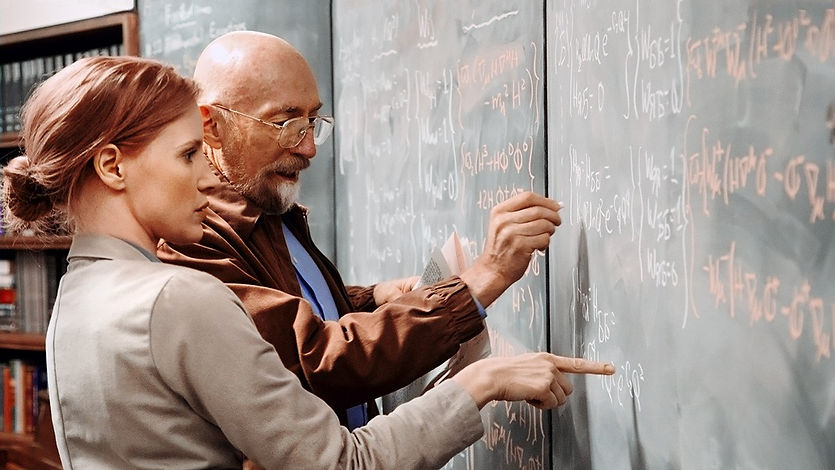
Great directors such as James Cameron or Christopher Nolan make it a point of honor to propose stories within phenomena or extraordinary environments that are always faithful to reality and the physical phenomena that go with it.
(Here actress Jessica Chastain with 2017 Nobel Prize winner in Physics, Kip Thorne on the set of C. Nolan's Interstellar).
About the Climate
The cataclysms that beset our characters in Shamas are built on real facts and scientific predictions. The force of nature is no longer to be demonstrated, the spectacular side of the infernal conditions that our heroes will have to face in order to carry out their mission will in fact serve the warning speech of the spokesmen of the environment.
It will also be a time to clarify the message that we hear too often and which, far too generalized, sometimes participates in the argument of the climate skeptics: "We (humans) are destroying the planet" or "Let's save the Planet!"
This is not true and the projection in our history will show us this. Indeed, the Earth has already experienced at least five mass extinctions, unimaginable catastrophes whose causes are not always known. Each time, the fossil record shows the end of animal and plant species all over the globe and each time life has reappeared and nature has regained its rights, all this in time scales that are of course beyond us.
What we are really destroying today is the fragile climatic balance that allows us to live on Earth in optimal conditions. What we are mostly destroying is the future of our grandchildren and of all the living beings that populate our world nowadays. This speech is, in my opinion, more meaningful and more unifying than asking the mass of active people to add to their daily difficulties the saving of a planet.
In our history, if some species manage to survive hidden or with the help of humans or shamans, we will observe the Beatrice, this new rose which, after thirty years of evolution in this new ecosystem, has adapted to the ultraviolet violence and will bloom naturally in this arid environment.
Beyond the weather, climatic variations lead to different behaviors that condition the life of the survivors. In the Chikas and resistant bases for example, the reddish light diffusing the necessary amount of ultraviolet to the human body to avoid vitamin D deficiency will influence our frames.

Among the Peoples
The key characters and peoples of our story are also directly inspired by real or fictional personalities who have influenced our History.
Around the plot of the hero
Dony Daëmon personifying Dionysus (The Daïmon). There are numerous references to Greek mythology and an illustrations of the Nietzschean paradigm of Aesthetics through the confrontation of Dionysus and Apollo. The opposition between the two divine figures was first posed by Plutarch (46-126 AD) and then taken up by Michelet in the Bible of Humanity (1864). In 1872, with The Birth of Tragedy from the Spirit of Music, a new conception of aesthetics appeared, from Friedrich Nietzsche, whose famous opposition of the Apollonian and the Dionysian comes back as a translation of Schopenhauer's opposition between intellect and will, and which so upset Richard Wagner.
Although art is the only activity that allows one to temporarily free oneself from "purpose" and thus "desire", both of which are generated by the will and both of which are sources of unhappiness, Music is, according to Schopenhauer, an immediate expression of this pure will, the fundamental reality of the lived world.
According to Nietzsche, the Dionysian designates the cohesion of the individual in the whole of nature, or the "original One", which includes everything that is vast, erratic, elusive, sensory, inspired, fiery, unchanging, linked not only to the origin of civilizations in Central Asia and the Middle East, but also forming the underpinning of its opposite, the Apollonian. That is to say what is framed, stable, ordered, classical, rational, regulated, measured, modal... supposed to be the proper of the Western "genius".
This conceptual duality of the arts, in the continuous confrontation of the hero Dony confronted with the real chaos of the world against his "nemesis", Epollion, taking advantage of a more aesthetic and comfortable reality, will transport us to the heart of a search for inner balance, which Friedrich Nietzsche calls "The Great Style".

Apollo and Dionysus - Leonid Ilyukhin
In the Spheres and the Cities
The references are mixed between historical characters from all horizons as, for example, the Elements Maria Salomea, Meryt Path or Ada Byronking representing respectively the scientist Marie Curie, Meryt-Ptah woman doctor of the ancient Egypt and Ada Lovelace pioneer in computer science in 1840.
Nb - It is often enough to " key in " on the Google engine the names of these characters to directly see the corresponding reference appear on the search page.
Among the Shamans
It is older legends, those of the Fertile Crescent of Mesopotamia, that connect our mutant characters. The famous ancestral tale, The Epic of Gilgamesh, revisited for the Fallen episode spearheads the cast. We will find Gilgam, Enkidi and Atra Hasis, in reference to Gilgamesh, Enkidu and Atrahasis the Sumerian Noah. Or Heduana for Enheduanna the first author of poems in history to have signed her works twenty centuries ago, Lugal'ann for Lugal-Anne-Mundu, the great king of the Sumerian city of Abab forty five centuries ago.
The Horscit
The resistance of Teikō built by the generals of the Land of the Rising Sun, logically resumes the fantastic stories of Japan, with General Izan Agiro (representing the primordial god Izanagi) father of Amatera, Tsuki and Soosan for the divine trinity Amateratsu, Tsukiyomi and Susanoo.
Okiku is inspired by an urban legend, a doll with hair that grows like real, in which would be locked the soul of the sick little girl who owned it until her death.
The division generals are direct references to the gods of the Shinto pantheon: Inari, Tenjin, Ryujin and all the others are powerful deities.
Along with the Technological Advance
In addition to the mysterious, yet crucial, breakthrough in the mastery of the primordial force of magnetism, many of the proposed innovations come from projects that scientists and researchers are already working on.
- Nuclear fusion, the ITER project and the Tokamak reactors are real. The calculations on helium 3 and the ambitions to recover it from the moon are just as real.
- The French company Clip Air also exists and this promising project is already being monitored by the largest manufacturers.
- Superconductivity and circuits in liquid nitrogen baths have been used for a long time in MRIs, for example.
- Biobuildings and the desire to produce healthy food in the heart of metropolises are already well advanced projects. Oxygenation through city infrastructures is already a success in Singapore.
- The same goes for several other more fanciful ideas (Fresh'eat or AnimaLight) which will also feed the episodes with references and advertisements of the future, systematically present in the middle of each episode.

Extrait du Film-Demo en annexe

